Shroud hooks, explained
A shroud is a strip of sheet steel folded over two edges of a screen and formed into a hook. The hooks catch the tension rails on a vibrating screen deck, so the mesh can be pulled tight and stay put while it shakes.
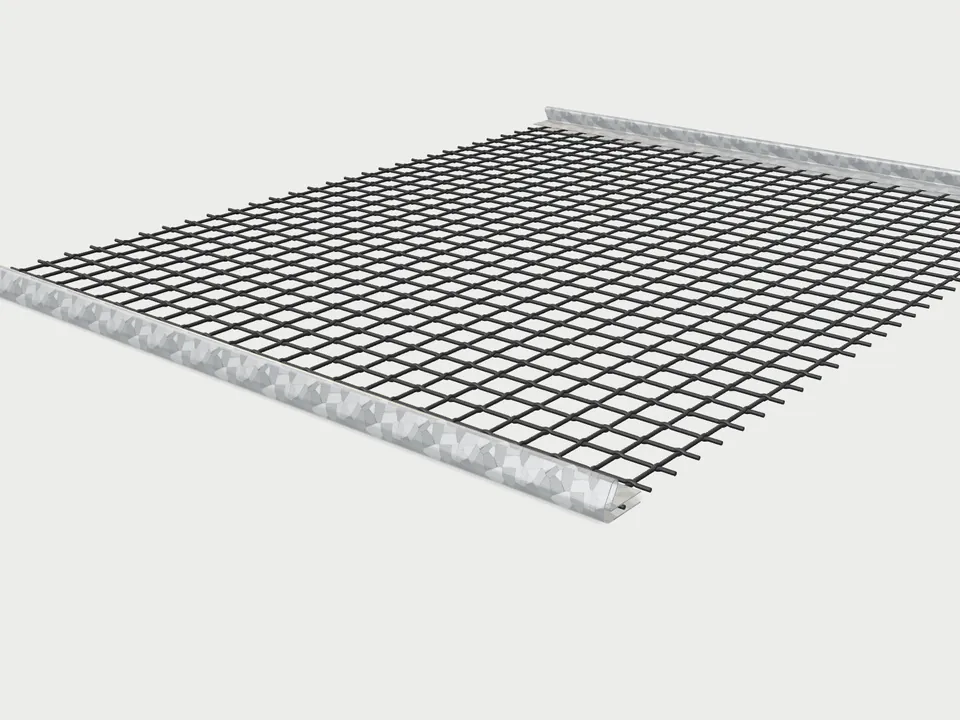
Hook styles
The hook has to match the rail on your machine. Pick one to see its shape. Not sure which you have? Send us the machine make and model, or a photo of the old screen's hook, from the customizer.
The standard single-fold hook. Fits most tensioned screen decks, and the one to pick if your old screen has a plain folded hook.
End-on view: the screen (dashed) comes in from the left, inside the folded strip.
Which edges get the hooks
Hooks go on one pair of opposite edges. On the ends (the form calls this Regular) puts them across the width, so the screen tensions along its length. On the sides (L slot) puts them along the length, so it tensions across the width. Look at which edges of your old screen have hooks.
Hooks up or down
Both up is the usual setup: both hooks open toward the top of the screen. One up, one down is for decks that pull from opposite sides. With one up and one down, tell us which end gets the lap, if you need one.
How to measure a hooked screen
OCW (outside, over the hooks) is measured from the outside of one hook to the outside of the other. ICW (inside) is measured between the hooks. Either is fine; just tell us which one you used, and measure the other direction edge to edge.
Replacing a screen? Measure the old one hook to hook, or measure the deck between its tension rails.
Laps
A lap is a strip of bare mesh left past the shroud at one or both ends, so two screens can overlap on the deck with no gap between them. Pick the lap size and which end in the customizer.
Strip metal
Shroud strips come in galvanized steel (the usual choice) or 304 or 316 stainless for wet, corrosive or food work. The strip doesn't have to match the mesh.
Holes & grommets
Screens that bolt or tie down instead of hooking can have holes punched along the edges. Grommets line the holes so the mesh can't tear. Give us the number of holes or the spacing.